Knowledge, AI and the Trivium
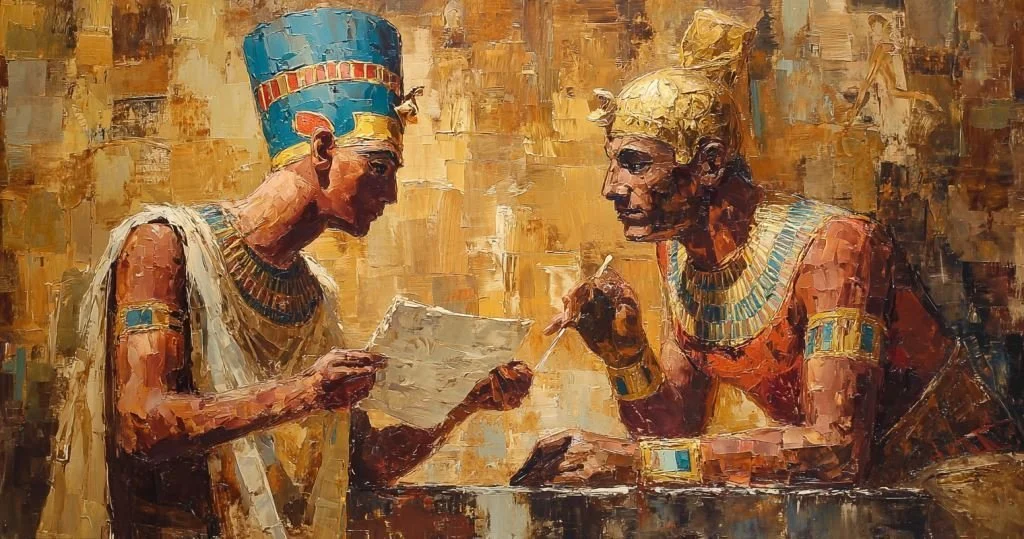
In Plato's Phaedrus, Socrates tells a story about the Egyptian god Theuth, a tireless inventor who has already given the world number, geometry, astronomy and, for lighter moments, dice. His latest invention is writing, and he brings it to King Thamus with the pride of a man unveiling a new phone. This, he says, will make the Egyptians wiser and improve their memories.
Thamus is unimpressed. Writing, he replies, will do the opposite. People will stop exercising their memories and rely on marks outside themselves. They will hear a great deal without being taught anything. They will seem to know much while knowing very little, and they will be tiresome company, because they will have the appearance of wisdom without the substance.
It is a delicious irony that we know this only because Plato wrote it down. It is a further irony that the complaint sounds so familiar. Every technology of knowledge, from the printing press to the pocket calculator to the search engine, has arrived with its Theuth promising enlightenment and its Thamus predicting ruin. Now we have the most generous gift of all. Artificial intelligence will draft the essay, summarise the report, diagnose the scan and, if asked nicely, write the sonnet. The old king's question has never been more pressing: when the answers are always available, what becomes of the mind that used to go looking for them?

Source: MDNazim
What Is Left to Us?
Let us concede the uncomfortable point at once. There are problems a machine now solves faster and better than any human. It folds proteins, spots tumours, translates Portuguese and reconciles spreadsheets without sighing. To pretend otherwise is to be the man who insisted his horse would outlast the motor car on grounds of loyalty.
The real danger is not that machines will think. It is that we will stop. Thinking about a hard problem is uncomfortable. It involves confusion, false starts, the indignity of being wrong and the long middle stretch where nothing seems to happen. If that discomfort can be delegated with a single prompt, many of us will delegate it, in the same way that very few of us now churn our own butter. Thamus feared the atrophy of memory. Our risk is the atrophy of judgement: the willingness to sit with a question long enough for it to change us.
So what remains distinctively ours? Not information, which is now as cheap as tap water. Not calculation, which was surrendered decades ago. What remains is the capacity to ask a question nobody has asked, to notice what matters, to connect two things that have never been introduced, and to care about the result. In a word, creativity. The person who scratched a cross-hatched pattern into a piece of ochre at Blombos Cave some 75,000 years ago had no curriculum, no examination board and no search engine. They had curiosity and a reason to make a mark. That impulse predates every school ever built. The question is whether our schools nurture it or quietly train it out of us.
Miss Sayers Mislays Her Tools
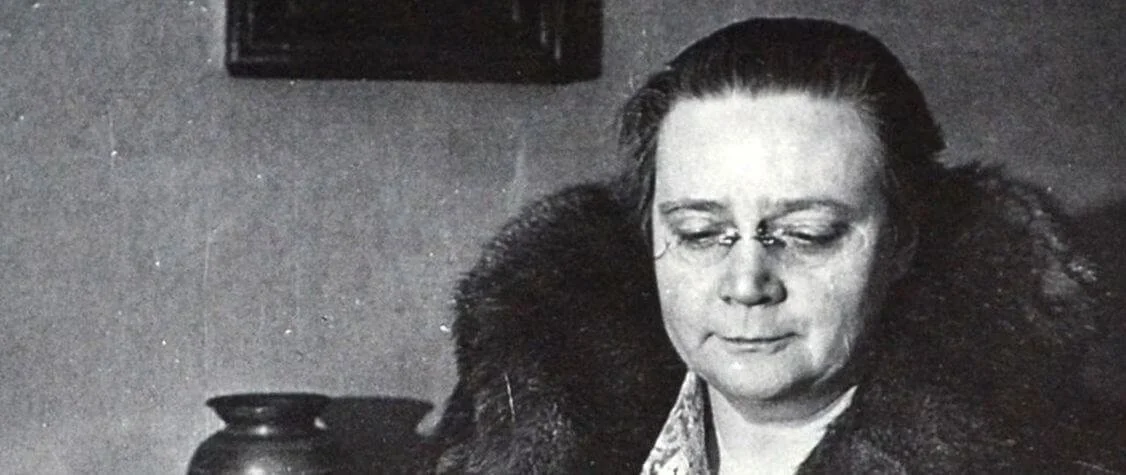
In 1947 Dorothy L. Sayers, better known for giving the world Lord Peter Wimsey, delivered a lecture at Oxford called "The Lost Tools of Learning". Her charge was simple and devastating. Modern schools, she argued, teach children subjects: history, chemistry, French, a little of everything. What they no longer teach is how to think. Pupils leave knowing a great many things and quite unable to work out anything new. She concluded that the sole true end of education is to teach people how to learn for themselves.
Her remedy was to look back to the medieval Trivium, the three foundational arts that preceded every other study:
• Grammar: the mastery of the raw material. Facts, vocabulary, structure, the things a mind must hold before it can play with them. Sayers noted that young children love to memorise, chant and collect, and that this is the stage to feed them.
• Logic (or Dialectic): the art of reasoning. How to define a term, test an argument, spot a fallacy and follow a chain of thought without falling off. This, she observed, suits the argumentative years of early adolescence, when contradiction becomes a hobby.
• Rhetoric: the art of expression. How to marshal what you know and what you have reasoned, and present it with clarity and persuasion. It is the stage of the young person who wants to be heard.
The beauty of the scheme is that it is not a list of subjects but a sequence of capacities. Grammar gives you something to think about, Logic gives you a way to think about it, and Rhetoric gives you a way to share what you have thought. Each subject is merely the occasion for exercising the tools.
Read today, the essay feels uncannily prophetic. An AI can supply the Grammar of almost any field in seconds. It can produce something that looks like Rhetoric on demand. What it cannot do is perform your Logic for you, at least not in any way that leaves you more capable afterwards. If we hand over all three, we become Thamus's nightmare: fluent, well-informed and unable to tell a good argument from a confident one. The Trivium, far from being a medieval curiosity, may be exactly the toolkit the AI age requires.
The School That Thinks It Is a Factory
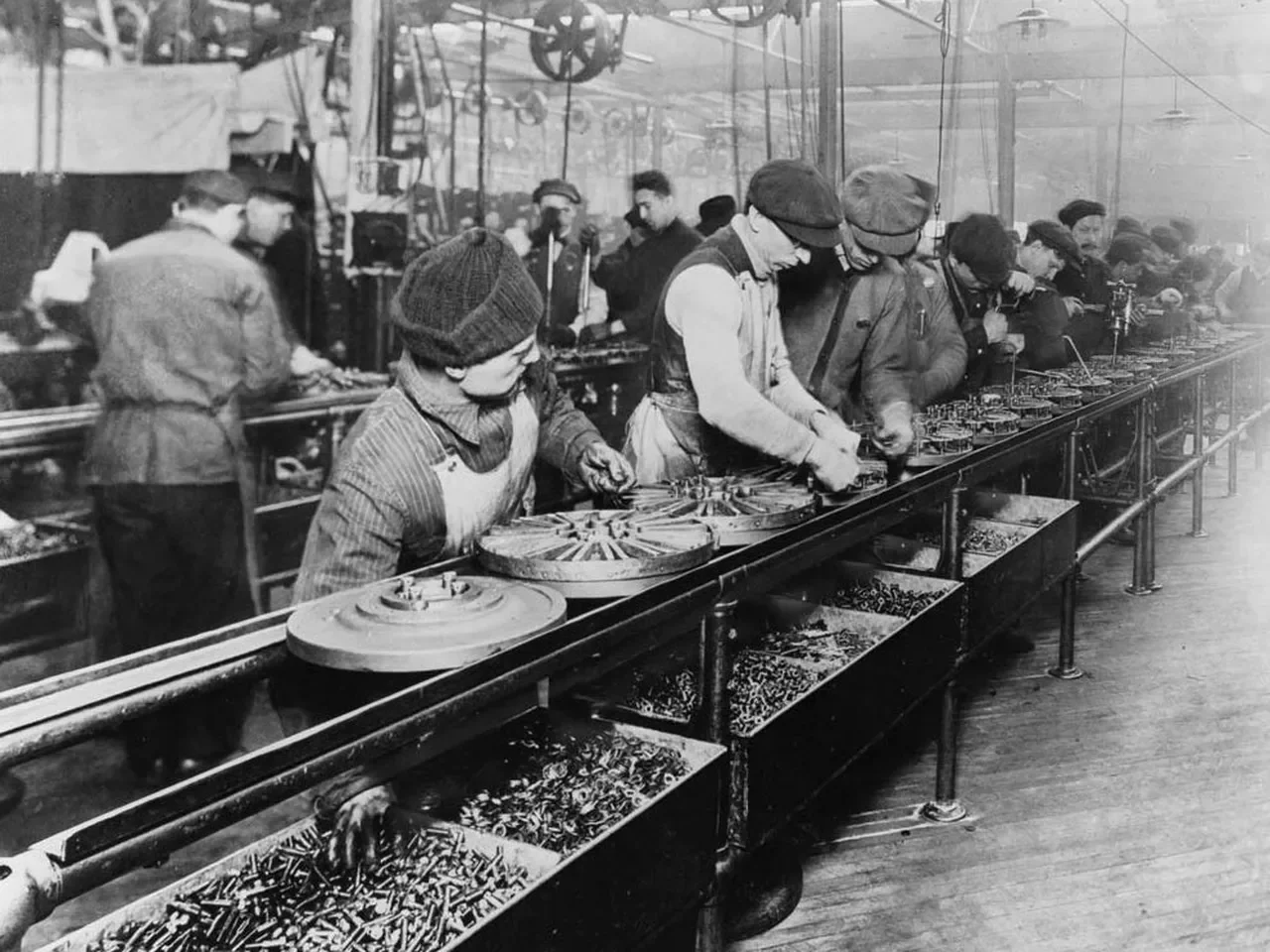
If Sayers diagnosed what we lost, the Industrial Revolution explains why we stopped looking for it. Mass schooling grew up in the nineteenth century alongside the mill and the mine, and it borrowed their habits. Bells mark the shifts. Pupils move along the line in batches sorted by age, as though their most important characteristic were their date of manufacture. Raw material goes in at five, quality control is applied at regular intervals, and a finished product rolls off at eighteen, stamped and graded for the labour market.
Sir Ken Robinson made this point more memorably than anyone. In his 2006 TED talk, "Do Schools Kill Creativity?", he argued that we educate children out of their creativity, and that the system was designed to meet the needs of industrialism. Its hierarchy of subjects, with mathematics and languages at the top and the arts at the bottom, reflected what a factory economy needed. He liked to say that if you were to visit our schools as an alien, you would conclude their purpose was to produce university professors, and that the rest of the body was merely a means of transport for the head.
Robinson was not alone. John Dewey, a century earlier, insisted that education is not preparation for life but life itself, and that children learn by doing and reflecting rather than by receiving. The Brazilian educator Paulo Freire attacked what he called the "banking" model, in which teachers deposit knowledge into passive students who are expected to store it and withdraw it on demand. The philosopher Alfred North Whitehead, in The Aims of Education, warned against "inert ideas": knowledge received into the mind without being used, tested or thrown into fresh combinations. And long before any of them, Plutarch observed that the mind is not a vessel to be filled but a fire to be kindled.
That last line is the hinge of the whole argument. A factory model treats the mind as a vessel, and AI is now the most efficient filling machine ever built. If school's job is to fill, it has been made redundant. If its job is to kindle, it has never been more needed. The factory metaphor is not merely outdated; in an age where the machines do the manufacturing, it is training children for jobs that machines will do better.
So What Exactly Is Creativity?
If creativity is to be our last redoubt, we had better know what we are defending. The popular image is unhelpful: a tortured genius, a paint-spattered smock, a muse who visits only the chosen. On that definition, most of us were never creative in the first place, and losing it would hardly matter.
John Cleese offers a far more useful account. In his celebrated lecture on creativity, he argued that it is not a talent but a way of operating. He distinguished between two modes. The closed mode is purposeful, focused and slightly anxious; it is how we get things done, meet deadlines and catch trains. The open mode is relaxed, playful and curious; it is where ideas come from. Neither is superior. The trick is to move between them: open to discover, closed to execute, then open again to see whether what you have made is any good.
Crucially, Cleese believed the open mode can be cultivated. It needs boundaries of space, so that you are protected from interruption, and boundaries of time, so that play has a beginning and an end. It needs the patience to tolerate the discomfort of not yet knowing, rather than grabbing the first adequate answer. And it needs freedom from the fear of making a mistake, because nothing inhibits creativity quite like the feeling that you must not be wrong.
Once creativity is understood as a mode rather than a gift, two consequences follow. First, it is not the property of the arts. The surgeon improvising a repair, the engineer rethinking a joint, the lawyer framing an argument nobody has tried and the shopkeeper rearranging a window are all operating creatively. Second, it can be taught, which means it can also be untaught. A system obsessed with right answers, rigid timetables and the terror of the wrong one is, by Cleese's measure, a machine for keeping people permanently in the closed mode.
Note, too, how neatly this maps onto the Trivium. Grammar supplies the materials. Logic supplies the discipline of the closed mode. Rhetoric, and the play that precedes it, opens the door to the open. Sayers and Cleese, an unlikely pairing, turn out to be describing the same toolkit.
What Is Education For?
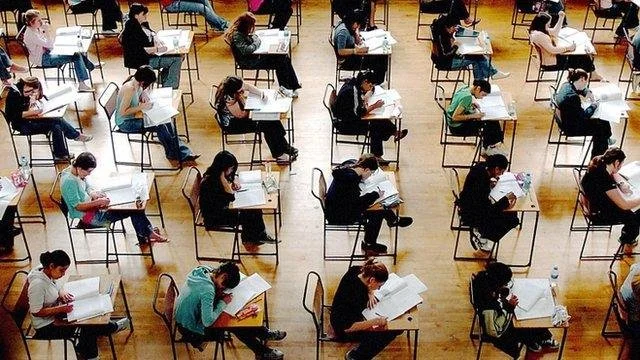
Which brings us to the question underneath all the others. If school is a conveyor belt to employment, and the employment is increasingly done by machines, the belt leads nowhere. Education must have a larger purpose: to equip people to cope with, and to thrive in, a world whose shape none of us can predict. That means teaching the tools rather than the contents. It means Grammar enough to have something to think with, Logic enough to resist the confident nonsense that AI can generate at scale, and Rhetoric enough to say something worth hearing. Above all it means protecting the open mode, the time and safety in which a young mind can wander, fail and find something new.
None of this requires abolishing knowledge or banning the machines. The calculator did not destroy mathematics; it freed mathematicians from long division. AI could do the same for thought, but only for people who still know how to think. Used by a mind that has been taught how to learn, it is a superb collaborator. Used by a mind that has only been taught what to learn, it is a crutch for a leg that never grew.
Thamus, it turns out, was half right. Writing did not make us forgetful fools; it gave us libraries, law and literature. But he was right that a tool which supplies answers can impoverish the person who stops asking questions. The difference lay not in the gift but in the education of those who received it.
Creative thinking, the ability to operate in the open mode and to do something unprecedented with what we know, is one of the last bastions of what it means to be human. It is the same instinct that moved a hand across a piece of ochre at Blombos. The urgent question is not whether the machines will take it from us. It is whether our schools, still tuned to the rhythm of the factory bell, will teach us to keep it. On the evidence so far, we have the right gift and the wrong education. Miss Sayers left us the tools. It is time we picked them up again.